The cast of tech titans behind the Trump inauguration podium is broadly interpreted as a sign of new-found alignment between Washington and Silicon Valley. Given legacy hostilities, the theatrics of Zuckerberg, Bezos, and Musk showing their deference to the incoming president was worth suffering through Inauguration Day bravado.
We wonder, however, if the Capitol Hill set-up is misconstrued. Could the peculiar dais jockeying actually be a sign of fear, rather than fealty? Silicon Valley may not be as resilient as we like to think. There are, after all, major chinks in the venture-capital armor.
Big tech—represented in part by Meta, Amazon, and Tesla at the inauguration—should not be confused with venture capital. They are symbiotic, though. The largest tech companies sprouted from venture capital and their executives act as spokespeople for the industry, setting investment trends and guarding against capricious regulation. They also influence disproportionately large pools of money allocated to the benefit of startup companies. Some of those young firms can be considered the future of American industry.
We think there are at least two trends keeping Silicon Valley executives awake at night. One concern is fresh dominance of the venture-capital industry by China. Another is a growing funding deficit from traditional institutional sources. Here is a brief look at both issues:
China: On Inauguration Day, the Shanghai Daily—an English language newspaper owned by the Chinese Communist Party—published a feature article about the launch of a government-backed fund with $1.4 billion in cash with a mandate to reshape emerging industries. “Its goal is to fast-track the transformation of scientific innovations into market-ready solutions.” The target list includes companies in information technology, space commerce, and advanced manufacturing. These are areas where US venture capital has monolithic interests. Chinese success in these fields will undercut the implied valuations of many US-backed firms, spotlighting overconfidence and speculation. Investor reaction would be ugly.
Institutional Investors: The past year was not especially kind to the US venture-capital industry. Total capital raised in 2024 was about $210 billion, according to a joint review by PitchBook and the National Venture Capital Association, but the biggest component of that figure was directed at so-called unicorn deals. In the absence of those outsized transactions, Silicon Valley would have been reset to 2018. One problem is that institutional investors are unwilling to commit to new deals when old transactions have yet to see an exit, tying up valuable capital. In other words, new money from big names is increasingly scant. The spending spree on artificial intelligence creates a different impression.
The US venture-capital industry is less healthy than commonly believed. For a private-sector leadership who validates itself on a global playing field and with an open spigot of cash, this murky reality is likely terrifying. The trip to Washington in the middle of January could be construed as a form of occupational escapism, complete with stylish celebrities and tasteful cuisine. The American actor John Wayne once said, “Courage is being scared to death, but saddling up anyway.”
The shadow of a lackluster venture-capital industry in Europe certainly amplifies this fear. The business on the other side of the Atlantic is littered with zombies. The Financial Times reports that some 30% of Europe-based venture-capital firms are not actively investing at this time. They attribute this lull to a “flight to quality” in which only a few checks are written to the largest companies, foregoing allocations to speculative opportunities. The scope of this shake-up is poorly reported; the venture-capital industry is guilty of toxic positivity.
Is the US venture-capital business cozying up to Washington as a type of insurance policy against prevailing macroeconomic crosswinds? We think that view is more plausible than a sudden “Make America Great Again” bromance with the White House. The trajectory today implies that Silicon Valley could eventually be ripe for government subsidies, either direct or indirect, to sustain intermediation activities. That point may sound far-fetched, but industrial history suggests otherwise. We recall that Silicon Valley was built in the 1950s and 1960s on the back of US defense spending. ■
Our Vantage Point: Steps by Silicon Valley to embrace the new administration are rooted in troublesome business trends. China threatens US dominance in venture capital, while institutional investors are parsimonious. To tech titans, the White House is a path to cash now.
Learn more at the Associated Press
© 2025 Cranganore Inc. All rights reserved.
Unauthorized use and/or duplication of any material on this site without written permission is prohibited.
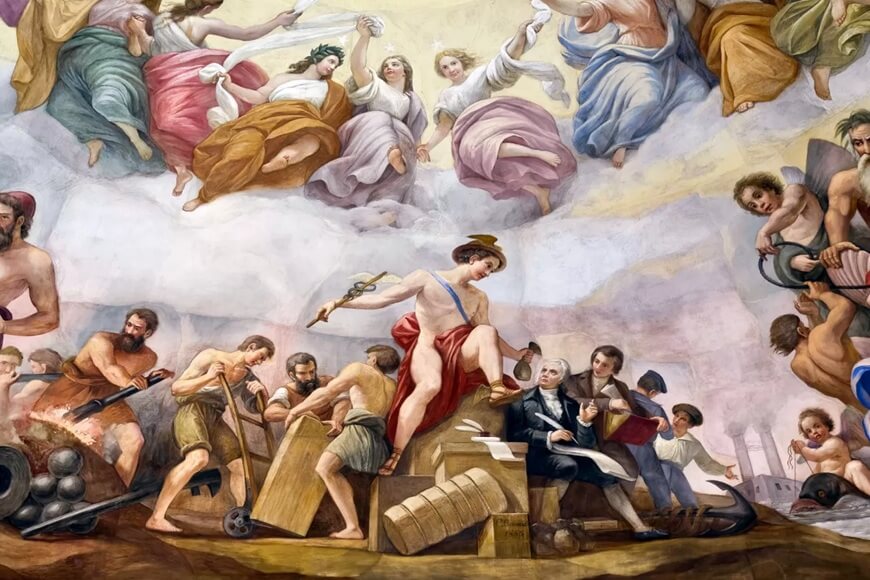
Image shows detail from the fresco in eye of the Capitol Rotunda. In this section of the “Apotheosis of Washington,” the Roman god Mercury hands a bag of money to Robert Morris, a prominent financier of the Revolutionary War. Credit: Architect of the Capitol.